Category: The Future

  • How Best Can Churches use AI and Technology?

    How Best Can Churches use AI and Technology?

    Aligning technology with ministry goals is crucial for churches to ensure that technological integration supports and enhances their mission rather than detracting from it. Here are some best practices:


    Establish Clear Technology Policies and Guidelines

    Start by formulating a mission statement for the technology team that aligns with the church’s overall mission. This ensures that all technological efforts are purposeful and support the church’s goals [6].  Develop a strategic plan that outlines how technology will be used to support various ministries and activities. This includes setting both long-term and short-term goals for technology use, ensuring that every technological investment is aligned with the church’s mission [5].


    Prioritize the Human Element

    Use technology to enhance the worship experience and foster community connections. For example, audio-visual equipment can make services more engaging, and live streaming can extend the reach to those unable to attend in person [1][2].  Ensure that technology complements rather than replaces personal interactions. For instance, while online platforms can facilitate communication and engagement, they should not replace face-to-face pastoral care and fellowship [3].


    Provide Ongoing Training and Education

    Offer regular training for staff and volunteers to ensure they are comfortable and proficient with the technology being used. This helps in maintaining a high standard of technical excellence and ensures that technology is used effectively [2]. Encourage continuous learning and adaptation to new technologies. This helps the church stay current with technological advancements and ensures that the technology used remains relevant and effective [4].


    Maintain a Balance Between Tradition and Innovation

    While integrating new technologies, ensure that the church’s core values and traditions are preserved. Technology should be used to support and enhance these values, not overshadow them [1][3]. Regularly evaluate the impact of technology on the church’s mission and values. This includes gathering feedback from the congregation and making necessary adjustments to ensure alignment [6].


    Foster Community Engagement and Accountability

    Encourage open dialogue and feedback from the congregation regarding the use of technology. This helps in understanding the needs and concerns of the community and ensures that technology is used in a way that benefits everyone [1].  Establish accountability measures to ensure that technology is used responsibly and ethically. This includes setting clear guidelines for online conduct and data privacy [5].


    Leverage Technology for Mission Enhancement

    Use technology to expand the church’s outreach efforts. This includes leveraging social media, podcasts, and online Bible studies to reach a broader audience and fulfil the church’s mission of spreading the Gospel [3][7]. Equip other ministries within the church with the necessary technological tools to enhance their effectiveness. This includes providing technical support and ensuring that all equipment is maintained and fully functional [2].


    By following these best practices, churches can ensure that technology is used in a way that aligns with their values and mission, enhancing their ability to serve their congregation and fulfil their spiritual goals.


    Citations:

    [1] https://www.parkchesterbaptistchurch.org/ministries/ministries/technology-ministry.html

    [2] https://richmondhill.church/tech

    [3] https://outreachmagazine.com/resources/76288-technology-and-the-church-what-you-need-to-know.html

    [4] https://www.fellowshipone.com/blog/7-ways-technology-improves-church/

    [5] https://www.greatchurchsound.com/blog/how-to-set-tech-goals-for-your-church

    [6] https://churchm.ag/every-church-tech-team-needs-mission-statement/

    [7] https://pushpay.com/blog/definitive-guide-to-church-technology/

    More Resources

    https://www.christiantechjobs.io/blog/what-is-church-tech-a-comprehensive-guide-to-church-technology

    https://www.playlister.app/blog/how-to-use-technology-to-make-your-church-more-efficient

    https://timetracko.com/blog/leveraging-technology-for-church-growth/

    https://get.tithe.ly/blog/church-technology

    https://www.ministrybrands.com/church/management/technology/

    https://www.christianitytoday.com/partners/pushpay/how-latest-technology-trends-are-shaping-your-church.html

    https://biblelines.app/why-the-church-needs-technology/

    https://www.allen-temple.org/ministries/congregational-stewardship/information-technology-ministry

    https://www.acstechnologies.com/church-growth/the-essential-guide-to-building-and-managing-your-churchs-it-budget/

    https://www.altarlive.com/blog/using-ai-for-ministry-a-revolution-in-church-leadership

  • How might AI affect the church?

    How might AI affect the church?

    AI could have a significant impact on the church in various ways, most of them positive.  However much will depend on the Church’s willingness to adopt the new practices and new ways and the extent to which changing societal pressures pressure the change to move in new directions.

    Pastoral Roles Transformation

    Pastors who primarily rely on dispensing information and teachings may find their roles partially taken over by AI-generated content. AI could effectively communicate spiritual truths. However, pastoral roles involving genuine engagement, empathy, understanding, and spiritual mentorship cannot be replaced by AI. These human elements will become more crucial.[1]

    AI-Generated Church Services

    While some churches might adopt AI-generated holographic presentations for preaching and worship, there could be a backlash as congregations desire authenticity. Real pastors and empathetic communities are likely to be valued over virtual experiences.[1]

    Job Replacement

    AI’s integration across industries threatens numerous jobs, including radiologists, auditors, bill collectors, screenwriters, fashion designers, and even computer programmers. Goldman Sachs projects AI could cause the loss of approximately 300 million jobs worldwide, potentially compelling governments to explore universal income programs.[1]

    AI in Advertising

    AI-generated holograms could replace human actors in commercials, making advertising more cost-effective and versatile. However, deepfake technology powered by AI raises concerns about misleading content, manipulation of public sentiment, and erosion of societal trust.[1]

    Routine Task Automation

    AI can automate routine tasks like recording donations and attendance data, allowing church staff to focus on other responsibilities.[3]

    Personalized Content

    AI can help personalize content by suggesting relevant Bible study materials, prayer schedules, or sermon topics based on data analysis, facilitating a deeper understanding of the Bible.[3]


    Potential Pitfalls

    There are concerns that large language models of AI could manipulate biblical texts and their interpretation to align with societal values, particularly where the common interpretation is not in accordance with good scholarship or the leading of the Spirit.  This could lead to weaker discipleship, a dissolution of the church’s witness, in turn leading to decreased church attendance, desensitization, and stifling creativity. Additionally, AI-generated sermons may limit unique perspectives and spiritual growth within the Christian community.[3]


    The church must navigate AI’s implications wisely, embracing its potential benefits while preserving the essence of faith-based practices, human connections, and the integrity of the gospel message.[1][2][3]


    Resources:

    [1] https://tristatevoice.com/2023/07/26/the-future-of-ai-10-global-implications-for-the-church-to-consider/

    [2] https://www.breezechms.com/blog/ai-and-the-church-possibilities-and-concerns

    [3] https://baptistnews.com/article/when-artificial-intelligence-finds-its-way-into-the-church/

    [4] https://www.altarlive.com/blog/the-impact-of-artificial-intelligence-on-the-church-embracing-the-opportunities

    [5] https://missionalmarketing.com/the-future-of-faith-7-ways-artificial-intelligence-is-transforming-church-marketing/

  • The change the church needs will come

    The change the church needs will come

    Change might not come from within.  It may not come from where we plan, or expect.
    Change will come from ‘Bethlehem’ rather than ‘Jerusalem’.  Micah 5v2

    The last Soviet leader, Mikhail Gorbachev died in 2022. He was 91.

    He is remembered in the West fondly for ending the Cold War. He is remembered less fondly in Russia for ending the Soviet Union. The thing is, he didn’t try to do either originally. What he was trying to do is, through Perestroika and Glasnost, reform the Soviet Union. Keep the system, but just remove some of the more unpleasant and inefficient bits from it.

    But once he started the process the whole thing started to unravel, and the entire country imploded. And that was that. Once it all collapsed, the Soviet Union ceased to exist within weeks (and nobody in the West or the East saw it coming, by the way), they’ve been trying to pick up the pieces ever since.

    So “Gorby” is an interesting case. A fellow who tried to do something good failed miserably but somehow ended up on the right side of history nonetheless. He will be missed. We could use more like him.

    Thirty years later after the fall of the Soviet Union, it’s still an interesting question. Starting from where Gorbachev was standing, what would one have done differently? Hard to say.

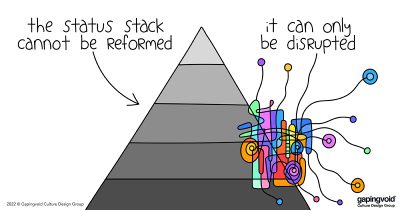
    Like Marc Andreesen said, once a culture gets to a certain state of stagnation, internal reform is impossible. Nothing to do but let the outside world eat its lunch. Let that be a lesson.

    The image was inspired by something Marc Andreessen, the legendary VC said in a podcast (The Knowledge Project #129), namely that when an organization gets to a critical mass of bureaucracy and stagnation, it can no longer be reformed from the inside. The only thing that can happen is that it can be toppled from the outside


    Credit (including image):  www.gapingvoid.com

  • Is the Church Losing Faith in Low-Income Communities?

    Is the Church Losing Faith in Low-Income Communities?

    A report on church closures in Greater Manchester reveals that more are being lost in areas of low income and deprivation.

    The report, Is the Church Losing Faith in Low-Income Communities in Greater Manchester?, was commissioned by Church Action on Poverty and compared the number of churches in the city in 2010 with those that remain in 2020.  One of the authors, the Rev Fiona Tweedie, told a Religion Media Centre briefing that they looked at five main denominations: Baptist, Roman Catholic, Methodist, Church of England and United Reformed.  Most church closures within the CofE, Catholic, Methodist and Baptist denominations were in the most deprived areas, the report said. Only the United Reformed Church had more closures in affluent areas than in low-income areas.

    It continued: “Reasons for church closures included: declining numbers attending church services; buildings falling into disrepair, coupled with churches being unable to afford their upkeep; and fewer priests and ministers to serve the churches. However, this … does not explain why many more churches have closed in deprived areas, in comparison with more affluent areas.”  Ms Tweedie said: “Sometimes while there’s fabulous work going on in deprived areas, sometimes there aren’t people to fight to save a church in the way that there are in some more affluent areas.”

    Niall Cooper, director of Church Action on Poverty, said there must be a reason why churches in deprived areas were closed more frequently and there was another story going on. “I’m not saying in most cases it’s a deliberate strategy. But unconsciously, there are forces at play, where churches with less resource, less money, potentially fewer human assets are the ones that close — and those will be the ones in low-income community areas.”  He said the report was inspired by a policy from the Church of Scotland 15 years ago, to target areas of deprivation as priority areas for the denomination, as “a theological imperative”.

    Eunice Attwood, the church on the margins officer for the Methodists, said she had been aware of closures in low-income communities for many years, but sometimes in such communities the building was absolutely essential and her team pleaded with churches to keep those buildings open.  However, the church was not just about buildings but communities, she said, and the Methodist Church was intentionally putting resources into low-income areas, to nurture communities — not buildings: “The church that emerges may look very different — we’ve seen walk-in churches, muddy church, a church that meets on a Wednesday, not a Sunday. New places for people need not to be tied to bricks and mortar.”

    The report contains the example of the Triangle Community Church, north of Bolton, where four Methodist churches were closed and a new centre built, providing a community café and activities for people in the neighbourhood.

    The Bishop of Manchester, David Walker, spoke of the Antioch Network, a group of community churches developing in Manchester on housing estates and inner-city areas. Money from central church funds is going to Manchester specifically for this purpose, he said: “We’re closing fewer buildings than we are opening new congregations.”

    He pointed to the reality that churches built in Victorian times served populations which had simply moved away and the buildings were not needed in the same areas. It would be like keeping a church open in a field in Norfolk near a village that had been destroyed by the Black Death. “If a population moves, you actually have to move where you’re putting the church,” he said, and suggested more work needed to be done to analyse population numbers in the areas where churches closed.

    The Rev Philip Brooks, deputy general secretary of mission for the United Reformed Church, said it would never shut a building unless there was local co-operation. Sometimes, however, buildings were a millstone.

    Ecumenical projects can combine to provide purpose-built community facilities, such as one in Salford which has a place for worship alongside space for a food bank, community gardens, community café, all important for the church in areas of deprivation.

    Researcher Deirdre Brower-Latz produced an accompanying report, What Does it Mean to be a Church on the Margins?, describing through interviews what church means to people living in areas of deprivation. Describing a church as on the margins was problematic. “It’s a very top-down understanding isn’t it?”, she said. “There’s almost an implied insult or a diminishing, or a potential power exchange that’s really unhelpful.” She told the briefing that their conversations with Christians in those churches had been “really wonderful”. “It opened up all kinds of conversations about inherent dignity, pride and communities that others would slight. A sense of ‘what does it mean to belong here?’, because … here is our home, and a place of life for us, and flourishing and hope. “The stories that emerge are full of ordinary miracles, tiny spaces of seeds of life, yeast, salt. It sounds very biblical, what people say back to you, you know, here’s the way we encounter Jesus in this space.”

    Kate Gray, minister of the Dandelion Community in Wythenshawe, Greater Manchester, said there was something behind the closure decisions about class, power, resource and numbers. Her church had been under threat of closure and was often spoken about as tiny, with 15 people maximum on a Sunday morning “if there was a revival” and between 400 to 600 people part of the community through the week, involved in community events such as a gym, carers group, mental health group, community café and food bank. But she told the briefing that the threat of closure had gone as the wider church had changed its approach in recent years and listened to local wisdom and experience, while the local church had “skilled up” to speak the language of the wider church and “join in middle-class conversations”.

    Eddie Tulasiewicz, of the National Churches Trust, challenged people on the call to talk about money as well as power. He said the government had given £50m via the Heritage Stimulus Fund, much of which went to beautiful churches with small communities. But there was a conversation needed about where the next tranche would go — to heritage or a community stimulus fund, he questioned. He urged people to contact their MP and local council and find if money was available. He said many churches lost out because they were not Grade I listed, which automatically attracted funds. But he cautioned against demolishing buildings: there was less climate impact if buildings were kept going.

    Reflecting on the report findings and the future of the church in deprived areas, Mr Cooper said they were communities of hope. “This is the gospel priority, to ensure that the poorest and most vulnerable communities are ones that are supported, to be the best communities that they can be. That’s why we’ve commissioned this. “And now we’re looking into the next phase about how we enable people in those communities for their voices to be heard, to shape the strategies and decisions of the churches as institutions, which ultimately will be how those communities get access to power and are able to ensure that they have dignity and agency. “This is not just a conversation about church, it’s how all communities are represented in society, and are able to articulate that they should get justice in terms of our wider decisions about resources within societies, communities, and ultimately as a country.”


    This article was written by Ruth Peacock and published here, in February 2023: https://religionmediacentre.org.uk/news/the-poorer-the-area-the-quicker-the-churches-are-closing/
    Photo by Kate Remmer on unsplash.com

  • In which direction is the church moving?

    In which direction is the church moving?

    So, in which direction is the church moving, or perhaps which are the most prominent winds in society which are going to move the church in a particular direction?  It is difficult to make predictions, but sometimes when one hears a consider thought it rings true.  Perhaps, something here might ring true with your experience and provide some guidance as to your ministry, the direction for your church, or simply give you hope.

    I stumbled across and article entitled “Ten (Very Different) Church Trends for 2022” by Thom S. Ranier.  You can find the article here: https://churchanswers.com/blog/ten-very-different-church-trends-for-2022/
    The article is worth a read, despite being over a year old, and you can click through and do that.  I am only going to highlight a few things which Thom has predicted and which I think are particularly interesting, and insightful.

    Thom predicted that:

    Worship attendance will average 80% of pre-COVID numbers. That has proved correct if perhaps a little optimistic.

    Neighbourhood churches will become a movement. He defines these as congregations that are laser-focused on ministering to a specific geographical area.  He is writing in an American context, but I think this is a particularly interesting in the UK context.  Is this perhaps what we are seeing in the growing number of churches evolving into community hubs and community centres?  Does this mean that we will see a decline in global mission and in the desire to support mission in other parts of the Connexion.  I hope not, but do think it might be happening already.  With this he suggests will come more community focus than any period in the last 30 years. If this is indicative of a stronger, local incarnation of the gospel that is good news, but if it simply drawing our vision and not seeing mission value beyond what will help us grow and survive as an institution that is really bad news.  Time will tell.  This relates to another prediction of Thom’s that there will be a far greater emphasis on evangelism than in the recent past.  It is no secret how much the Methodist Church is putting into Evangelism and Growth, but again the value will be shown in whether this proves to be truly missional or about institutional survival.

    Finally, for this post, Thom predicts that the micro church could become a movement.  (A micro church is defined as a congregation with 30 or fewer attendees). This is certainly true and an intentional move in some areas of the church, and one that was growing until COVID.  It also links back to our Wesleyan Revival Heritage of societies, class meetings and bands.  What is interesting is that there as so many churches in the UK which fit into this category (but are not branded micro-churches), and fail to recognise the positive aspects which they could embrace.  Of course, most newly established micro churches have little or no administrative obligations, and are even less likely to have building maintenance and assessment obligations.  So, to make the most of this opportunity and to really embrace the trend we will need a new structure or a new way of operating.

    More on those new structures and ways of operating as well as related trends of ministry in the next bog post.


    Photo by Daniel Gonzalez on Unsplash

  • Common Church Problems (No 1 in a series)

    Common Church Problems (No 1 in a series)

    I’ve dealt with a wide range of church issues over my career. I’m well-equipped to offer insight and suggestions because many of these challenges are similar to those I’ve encountered elsewhere.

    So, what are the typical issues facing churches?
    Do you know of any that might affect your church?

    Without a clear vision and strategy, people are likely to do their own thing. If there is no clear vision, there will be division – literally, two visions. Organizational drift and leadership that is based on reaction rather than intention are the outcomes. Uncertainty and disorientation pervade as a result of a lack of a clear guiding image. This issue is far too common. Clarity, purpose and direction, are all provided by a vision. The nature of vision should be prophetic; that is, focused on the future and coming from God’s heart. A vision statement can be beneficial, but only when it is more than clever words on a piece of paper.
    If your church has a clear vision but no progress, your strategy might not be aligned with it. Saying you’re going somewhere is one thing but it takes consistent and enduring action to move towards that goal.

    We are going nowhere if the culture doesn’t support the vision. A clear vision helps us understand what we’re trying to accomplish. However, the culture determines the growth and will play a significant role in our vision’s success or failure. Culture must be developed intentionally and strategically, with clear values rooted in what we believe about our mission and vision.
    People’s hearts and minds cannot be changed by a vision statement, but culture does have the power to do this. However if people fail to adopt beliefs and behaviours that are consistent with the church’s vision, in other words if they are not discipled, we will see the culture clashes and culture gaps which cause leaders to feel defeated and frustrated.  We have to disciple – teach, model, share and reinforce our core values.

    Structures must encourage, rather than prevent growth. Church structure should be organic and flexible to grow with where God is leading. It is about who you are and what you do, and is reflected in your policies, procedures and systems.  Structure can facilitate God’s blessings, resources, and opportunities but excessive, or insufficient, structure can undermine the same.  A church should not be built around structure. Instead, structure ought to act like a trellis, supporting the development of a culture that serves the vision.
    Sometimes churches have historic and traditional ministry activities that impede their expansion.

    The church is the only organisation which, by definition, exists for those who are not a part of it. The church will eventually dwindle and disappear if it fails to prioritise taking the good news of the gospel to those who have not yet accepted it. You can take a quick inventory of your ministries by asking, “How many of our ministries serve those outside of the church?”
    We set ourselves up for failure when we devote our resources and time to making those around us happy. Examining how we can serve the world and spread the kingdom through word and deed is better, and more biblical. If you look around the church and see no new faces, recognise that as a problem.

    Often the discipleship of members is inadequate. In most cases there is no churchwide plan to people grow into Christian, because there is no culture of discipleship.
    The ministries and programs are not bad, in and of themselves, but, often, they are hit-and-miss in terms of discipleship. People are empowered to take specific actions when there is a clear path. They should have access to resources, opportunities, tools, and people that will help them develop their faith.

    There is too much hesitation regarding digital ministry, including our internal and external communications. Technology is constantly evolving, but when it comes to online ministry, many churches are not moving with the trends and falling further behind. WE don’t just need a static church website we need to find ways of doing digital ministry well.
    This is the way forward, regardless of what you think about social media, the internet, and digital ministry. There are difficulties associated with technology and social media and it has the potential to cause a great deal of harm; however, this is not an issue pertaining to the church; rather, it is an issue pertaining to society. It can also bring a lot of opportunities and benefits.

    Teams can increase ministry effectiveness, but difficult issues arise when teams are imbalanced. This could be caused by uneven power dynamics, control, a lack of empowerment, a lack of awareness of dysfunctions in leadership styles, teams with too few gifts or experiences, or teams with gifting gaps. As previously stated, the culture of a church is shaped by its leadership teams, so a dysfunctional team leads to a dysfunctional culture. That’s why the New Testament has a lot to say about who belongs on a church leadership team and who shouldn’t. Identifying your team’s temperaments, ministry interests, and leadership styles are excellent first steps.

    There is a declining pool of leaders in the church at the moment. Sometimes that is because there are no new leaders coming forward, sometimes because the leadership training is ineffective and sometimes because we fail to hand leadership on to those who can grow into it. We want leaders who are pretty much like us, who won’t shake things up too much or take us off in a new direction.
    Sometimes the problem is from the other side – there are more things that need a lead than there are leaders to take them on.  There are too many ministries going on at once. It is better to wait for a leader than to start ministry too quickly.  Churches should be intentional in creating leadership pipelines to find, educate, and promote leaders to various levels of ministry leadership; leadership pipelines that start at the fringes guided by values like equality, diversity and inclusion.


    Regardless of the issue which your church is facing, it is not new and you are not alone. Others will have dealt with it and come out on the other side. Often it is helpful to gain an outsider’s perspective in order to better understand the real issues.

    Photo by Kimson Doan on Unsplash

  • What does the future hold? (2)

    What does the future hold? (2)


    It is difficult to predict with certainty what the future of the Christian church will be. However, there are a few potential developments that could shape the future of the church.
    One possibility is that the Christian church will continue to see a decline in membership and influence in the Western world, as has been the case in recent decades. This could be due to a variety of factors, such as the secularization of society, the rise of alternative belief systems, and the failure of the church to adapt to changing cultural norms. If this trend continues, it could lead to a further erosion of the church’s influence on public policy and societal values.

    On the other hand, it is also possible that the Christian church will experience a resurgence in the Western world, particularly if it is able to adapt to the changing needs of society and provide compelling answers to the spiritual and moral questions facing people today. This could involve the church becoming more inclusive and welcoming to a diverse array of people, as well as finding ways to address contemporary issues such as social justice, environmentalism, and technology.

    In the global context, the Christian church is likely to continue to grow in parts of the world where it is not yet well established, such as Africa, Asia, and South America. This could be due to the spread of Christianity through evangelism and missionary work, as well as the appeal of the message of hope and redemption offered by the faith.

    Regardless of what the future holds, it is important for the Christian church to remain true to its core values and teachings, while also being open to change and innovation. This will involve finding ways to adapt to the changing needs of society while also staying true to the principles and traditions of the faith. By doing so, the church can continue to be a source of hope, inspiration, and guidance for people around the world.


    This blog post created in exactly the same way as the previous one, written by an artificial intelligence robot
    after being prompted to "write 300 words on the future of the Christian church". It took about 30 seconds.
    Four options for the picture were generated by the prompt asking for "a line drawing of a man walking to church".
    That took about 15 seconds. 
    
    What does that mean for the way that we do things? 
    How can we use this technology well?
  • What does the future hold?

    What does the future hold?

    It is difficult to predict with certainty what the future holds for the Christian church, as it depends on a variety of factors such as shifts in societal values and cultural norms, technological advancements, and the actions and decisions of church leaders and individual believers. However, there are a few possible developments that may shape the future of the Christian church.

    One potential trend is the continued diversification of the global Christian population. Christianity is currently the largest religion in the world, with roughly 2.4 billion followers. However, the distribution of Christians is not uniform, and the majority of believers are concentrated in certain regions, such as Latin America and Sub-Saharan Africa. As the global population continues to grow and shift, it is likely that the demographics of the Christian church will also change, leading to a more diverse body of believers with a range of cultural and societal experiences.

    Another potential development is the increasing role of technology in Christian worship and religious practice. Many churches have already embraced technology by streaming their services online and using social media to connect with members and share teachings. In the future, it is possible that virtual reality and other emerging technologies may be used to create immersive worship experiences or to facilitate remote participation in religious events.

    There may also be shifts in the way that the Christian church engages with contemporary issues and challenges. In recent years, there has been a trend towards greater social and political activism among some Christian groups, as believers seek to address issues such as poverty, racial inequality, and environmental degradation. It is possible that this trend will continue in the future, with the Christian church playing an increasingly visible role in advocating for social justice and promoting positive change in the world.

    Overall, the future of the Christian church is likely to be shaped by a combination of external factors and the actions and decisions of believers and church leaders. While it is impossible to predict exactly what the future will hold, it is clear that the Christian church will continue to be a vital and influential force in the world, bringing hope, healing, and spiritual guidance to millions of people around the globe.


    This blog post was written by an artificial intelligence robot after being prompted to "write 300 words on the
    future of the Christian church". It took about 30 seconds.  
    Four options for the picture were generated by the prompt asking for "a line drawing of a man walking to church".
    That took about 15 seconds.
    
    What does that mean for the way that we do things? 
    How can we use this technology well?
  • ‘Uncertain times, unsettled lives’

    ‘Uncertain times, unsettled lives’

    This post by futurist, Keith Coats, was shared by Tomorrow Today Global.  Sign up for their newsletter. it is well worth it.
    TL:DR?  At least, read the last two paragraphs.


    In September the United Nations Development Program published their ‘Human Development Report’ which described the state of play as being one of a ‘nagging sense that whatever control we have over our lives is slipping away, that the norms and institutions that we used to rely on for stability and prosperity are not up to the task of today’s uncertainty complex’. It went on to say that ‘for many, getting from point A to point B in their lives and in their communities feels unclear, unsure, hard – harder still when persistent inequalities, polarisation, and demagoguery make it difficult to agree on what point B even is and to get moving’.

    The tagline of this astute commentary? ‘Uncertain times, unsettled lives’.

    Four words that capture the essence of a year that started with the hope of emerging from the grip of the pandemic and is ending with two major nations frozen in an exhausting and senseless conflict. A conflict that has rekindled scenes reminiscent of WW2 with the liberation of a European city (Kherson) – whoever would have thought that we would see such images in 2022! It is a conflict that has had both far reaching consequences (the disruption to the global food supply chain) and one that invokes the unthinkable, the threat of deploying nuclear weaponry.

    Author and activist, Arundhati Roy, said that historically, pandemics have forced humans to break with the past and imagine their world anew. Prior to the pandemic, we seemed to believe that bulletproof strategic plans would be enough to see us through any disruption and illuminate our pathway into the future. The pandemic stripped that assumption bare and revealed our best laid plans for what they were: defenceless barricades against the irrepressible incoming tide. I am reminded of the 19th-century English poet, Alfred Edward Houseman, who wrote, ‘what shall I build or write / Against the fall of night / Shall it be Troy or Rome / I fence against the foam / Or my own name to stand / Before I depart for aye’. It was President Eisenhower who, drawing on his military background, understood the foolishness of reliance on plans when faced with uncertainty and unpredictability: “Plans are foolish, but planning is essential” was his provocation. As any military person knows, at first contact the best intended plans go out the window.

    So, the pandemic forced on us a short-sighted focus, one imbued with a sharp sense of urgency on ‘sense-making’ – What has just happened? What is it that we need to do now? This sense-making will rumble on into the foreseeable future as we continue, with the vantage of hindsight, to make sense of the time from which we are emerging. For example, we are yet to appreciate the full extent of the mark it has left on a generation whose critical development period intersected with the peak of the pandemic. During COVID-19, more than one billion students lost an estimated six to twelve months of learning. In previous pandemics, such as the 1918 flu-pandemic, disrupted schooling, for those between fourteen and seventeen directly correlated to lower wages throughout their lives. A World Economic Forum report has described the pandemic as an ‘economic wrecking ball, with intergenerational consequences’. It will also be looked back on as the time that our understanding of how ‘work works’ was irrevocably changed.

    2022 has seen us embark on the low foothills of such sense-making. We now find ourselves in territory signposted everywhere we dare to look, with signage that urges us to ‘rethink’ and ‘reimagine’ pretty much everything – ourselves, our work, our world. It is likely to be a limited-time only invitation but if there is to be a silver lining to the darkness that was the pandemic, this is it! In the midst of the prevailing brittleness, anxiety, and incomprehension, there is hope offered through the extended invitation to rethink and reimagine.

    [….] Let me sign off by dabbling with Greek mythology. Proteus was the son of Poseidon, the god of the sea (who was also the overseer of water in general, earthquakes, and horses…quite a portfolio that!). Our friend Proteus had two very cool superpowers: Firstly, he knew the truth about the past, the present, and the future [….] But (there is always a ‘but’ isn’t there!), to get that truth, you had to defeat Proteus in battle and that brought into play his second superpower: He could shift shape at will. He could transform himself into a mountain, a lion, a wave, a fire…anything really and so you can instantly appreciate just how formidable that made him!

    So why this foray into Greek myth?  Well, I think that organisations should stop always trying to specifically anticipate what is around the corner (just accept that there is some disruption lurking there) and instead, work on building the capacity to ‘shift-shape’ instantaneously. To be like Proteus. What might this look like for you and your organisation? If you see this as a quest – and following a quest is nothing more or less than being an asker of questions – then what are the questions you should be asking but aren’t when it comes to building this kind of adaptability?


    Photo by Markus Spiske on Unsplash
    Keith Coats is a founding partner of TomorrowToday Global and leadership specialist. He is now based in Cape Town, South Africa having relocated from London towards the end of 2021. Keith works with blue chips companies and in multiple business school leadership programmes worldwide helping senior leaders prepare today for the challenges and threats of tomorrow…and sometimes, the ‘day after tomorrow’. In 2022 Keith’s travel has included working throughout the UK, the USA, Saudi Arabia, Dubai, Abu Dhabi, Germany, Switzerland, Singapore, and of course, South Africa.
  • Four key shifts facing the Church

    Four key shifts facing the Church

    In a book ‘Red Skies: 10 Essential Conversations Exploring Our Future as the Church‘, Rich Robinson writes about four key shifts that the church has to wrestle with in the next few years. His thoughts are based on the fact that rather than act as a one-man band or provide an expert-led class for students, Jesus’ foundation and focus was to create a community of disciple-makers. And those disciple-makers went on to birth the early church.

    That church is a body – interconnected and interdependent, yet we work in silos following the model of European Christendom. We need a new map. We need to recapture and reimagine the church as a movement of disciples, asking ourselves, “What would a collaborative, dynamic, authentic, sacrificial, generative and innovative community of Christlike leaders look like?”

    The four key shifts could help transition to answers to this question. They are:

    Shift 1: As generations age, the values of the millennial-influenced worldview will increasingly become normative.
    A shift away from the ‘big boss man’ and edicts on high towards shared access to information, communal decision-making, and issues of justice, environmental care, equality, common good, and equity. This shift will challenge the church to once again be the prophetic agency it has always been called to be. The millennial generation longs for purpose and this will influence the church to be a force for creativity and innovation through communities, families, social enterprises and business, across all strata of society.

    How can you help this shift?

    • Invite and involve different generations and diverse voices around your decision-making table.
    • Create space for ideas around possibilities or problems you have as a church.
    • Identify an issue e.g. equality, environmental care and engage with it as a church community.

    Shift 2: As adaptive challenges increase, the necessity of embracing and leveraging collective intelligence will yield disproportionate returns.
    A shift away from ‘solo-heroic leaders’ towards co-design, shared process, empowered teamwork, and mutual efforts of innovation. Think Clapham Sect, Malcolm Gladwell’s Tipping Point, etc. Could you create a team around an innovative, impactful goal and trial one or two projects.

    Shift 3: In a digital world, the online reality is here to stay.
    A shift away from corner offices or closed doors, towards networked, digital, dispersed teams. There are global online teams, global online businesses. How can the church take advantage of links to shared resources, people with experience, new relational connections? We are no longer constrained by the local. Why not identify some digital natives and ask for recommendations for your church.

    Shift 4: As times change, the template for the leader will return to the original Founder.
    The first 3 shifts will influence a fourth shift, which will involve returning to the person and pattern of Jesus as our role model for life and leadership. Jesus chose his core team and put a succession plan in motion. They had normal jobs, living unimpressive, ordinary lives. They were not cultural icons, endlessly ‘friended’ on social media. They, in turn, equipped others. This is an opportunity for us to re-imagine leadership, reimagine community, reimagine what we have and what we can be together. Seminaries need to change their leadership programmes.

    The challenge is that we have institutionalised much of our church life, and we are likely to defend or tweak it rather than making the words, works and ways of Jesus our defining narrative.
    This will take leadership rather than management.


    From an essay by Rich Robinson,via Word on the Streets
    Photo by Javier Allegue Barros on https://unsplash.com