Blog

  • What does the future hold? (2)

    What does the future hold? (2)


    It is difficult to predict with certainty what the future of the Christian church will be. However, there are a few potential developments that could shape the future of the church.
    One possibility is that the Christian church will continue to see a decline in membership and influence in the Western world, as has been the case in recent decades. This could be due to a variety of factors, such as the secularization of society, the rise of alternative belief systems, and the failure of the church to adapt to changing cultural norms. If this trend continues, it could lead to a further erosion of the church’s influence on public policy and societal values.

    On the other hand, it is also possible that the Christian church will experience a resurgence in the Western world, particularly if it is able to adapt to the changing needs of society and provide compelling answers to the spiritual and moral questions facing people today. This could involve the church becoming more inclusive and welcoming to a diverse array of people, as well as finding ways to address contemporary issues such as social justice, environmentalism, and technology.

    In the global context, the Christian church is likely to continue to grow in parts of the world where it is not yet well established, such as Africa, Asia, and South America. This could be due to the spread of Christianity through evangelism and missionary work, as well as the appeal of the message of hope and redemption offered by the faith.

    Regardless of what the future holds, it is important for the Christian church to remain true to its core values and teachings, while also being open to change and innovation. This will involve finding ways to adapt to the changing needs of society while also staying true to the principles and traditions of the faith. By doing so, the church can continue to be a source of hope, inspiration, and guidance for people around the world.


    This blog post created in exactly the same way as the previous one, written by an artificial intelligence robot
    after being prompted to "write 300 words on the future of the Christian church". It took about 30 seconds.
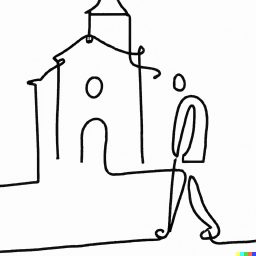
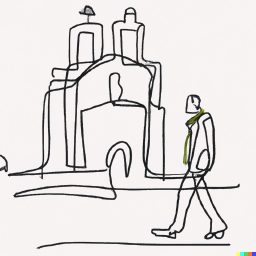
    Four options for the picture were generated by the prompt asking for "a line drawing of a man walking to church".
    That took about 15 seconds. 
    
    What does that mean for the way that we do things? 
    How can we use this technology well?
  • What does the future hold?

    What does the future hold?

    It is difficult to predict with certainty what the future holds for the Christian church, as it depends on a variety of factors such as shifts in societal values and cultural norms, technological advancements, and the actions and decisions of church leaders and individual believers. However, there are a few possible developments that may shape the future of the Christian church.

    One potential trend is the continued diversification of the global Christian population. Christianity is currently the largest religion in the world, with roughly 2.4 billion followers. However, the distribution of Christians is not uniform, and the majority of believers are concentrated in certain regions, such as Latin America and Sub-Saharan Africa. As the global population continues to grow and shift, it is likely that the demographics of the Christian church will also change, leading to a more diverse body of believers with a range of cultural and societal experiences.

    Another potential development is the increasing role of technology in Christian worship and religious practice. Many churches have already embraced technology by streaming their services online and using social media to connect with members and share teachings. In the future, it is possible that virtual reality and other emerging technologies may be used to create immersive worship experiences or to facilitate remote participation in religious events.

    There may also be shifts in the way that the Christian church engages with contemporary issues and challenges. In recent years, there has been a trend towards greater social and political activism among some Christian groups, as believers seek to address issues such as poverty, racial inequality, and environmental degradation. It is possible that this trend will continue in the future, with the Christian church playing an increasingly visible role in advocating for social justice and promoting positive change in the world.

    Overall, the future of the Christian church is likely to be shaped by a combination of external factors and the actions and decisions of believers and church leaders. While it is impossible to predict exactly what the future will hold, it is clear that the Christian church will continue to be a vital and influential force in the world, bringing hope, healing, and spiritual guidance to millions of people around the globe.


    This blog post was written by an artificial intelligence robot after being prompted to "write 300 words on the
    future of the Christian church". It took about 30 seconds.  
    Four options for the picture were generated by the prompt asking for "a line drawing of a man walking to church".
    That took about 15 seconds.
    
    What does that mean for the way that we do things? 
    How can we use this technology well?
  • ‘Uncertain times, unsettled lives’

    ‘Uncertain times, unsettled lives’

    This post by futurist, Keith Coats, was shared by Tomorrow Today Global.  Sign up for their newsletter. it is well worth it.
    TL:DR?  At least, read the last two paragraphs.


    In September the United Nations Development Program published their ‘Human Development Report’ which described the state of play as being one of a ‘nagging sense that whatever control we have over our lives is slipping away, that the norms and institutions that we used to rely on for stability and prosperity are not up to the task of today’s uncertainty complex’. It went on to say that ‘for many, getting from point A to point B in their lives and in their communities feels unclear, unsure, hard – harder still when persistent inequalities, polarisation, and demagoguery make it difficult to agree on what point B even is and to get moving’.

    The tagline of this astute commentary? ‘Uncertain times, unsettled lives’.

    Four words that capture the essence of a year that started with the hope of emerging from the grip of the pandemic and is ending with two major nations frozen in an exhausting and senseless conflict. A conflict that has rekindled scenes reminiscent of WW2 with the liberation of a European city (Kherson) – whoever would have thought that we would see such images in 2022! It is a conflict that has had both far reaching consequences (the disruption to the global food supply chain) and one that invokes the unthinkable, the threat of deploying nuclear weaponry.

    Author and activist, Arundhati Roy, said that historically, pandemics have forced humans to break with the past and imagine their world anew. Prior to the pandemic, we seemed to believe that bulletproof strategic plans would be enough to see us through any disruption and illuminate our pathway into the future. The pandemic stripped that assumption bare and revealed our best laid plans for what they were: defenceless barricades against the irrepressible incoming tide. I am reminded of the 19th-century English poet, Alfred Edward Houseman, who wrote, ‘what shall I build or write / Against the fall of night / Shall it be Troy or Rome / I fence against the foam / Or my own name to stand / Before I depart for aye’. It was President Eisenhower who, drawing on his military background, understood the foolishness of reliance on plans when faced with uncertainty and unpredictability: “Plans are foolish, but planning is essential” was his provocation. As any military person knows, at first contact the best intended plans go out the window.

    So, the pandemic forced on us a short-sighted focus, one imbued with a sharp sense of urgency on ‘sense-making’ – What has just happened? What is it that we need to do now? This sense-making will rumble on into the foreseeable future as we continue, with the vantage of hindsight, to make sense of the time from which we are emerging. For example, we are yet to appreciate the full extent of the mark it has left on a generation whose critical development period intersected with the peak of the pandemic. During COVID-19, more than one billion students lost an estimated six to twelve months of learning. In previous pandemics, such as the 1918 flu-pandemic, disrupted schooling, for those between fourteen and seventeen directly correlated to lower wages throughout their lives. A World Economic Forum report has described the pandemic as an ‘economic wrecking ball, with intergenerational consequences’. It will also be looked back on as the time that our understanding of how ‘work works’ was irrevocably changed.

    2022 has seen us embark on the low foothills of such sense-making. We now find ourselves in territory signposted everywhere we dare to look, with signage that urges us to ‘rethink’ and ‘reimagine’ pretty much everything – ourselves, our work, our world. It is likely to be a limited-time only invitation but if there is to be a silver lining to the darkness that was the pandemic, this is it! In the midst of the prevailing brittleness, anxiety, and incomprehension, there is hope offered through the extended invitation to rethink and reimagine.

    [….] Let me sign off by dabbling with Greek mythology. Proteus was the son of Poseidon, the god of the sea (who was also the overseer of water in general, earthquakes, and horses…quite a portfolio that!). Our friend Proteus had two very cool superpowers: Firstly, he knew the truth about the past, the present, and the future [….] But (there is always a ‘but’ isn’t there!), to get that truth, you had to defeat Proteus in battle and that brought into play his second superpower: He could shift shape at will. He could transform himself into a mountain, a lion, a wave, a fire…anything really and so you can instantly appreciate just how formidable that made him!

    So why this foray into Greek myth?  Well, I think that organisations should stop always trying to specifically anticipate what is around the corner (just accept that there is some disruption lurking there) and instead, work on building the capacity to ‘shift-shape’ instantaneously. To be like Proteus. What might this look like for you and your organisation? If you see this as a quest – and following a quest is nothing more or less than being an asker of questions – then what are the questions you should be asking but aren’t when it comes to building this kind of adaptability?


    Photo by Markus Spiske on Unsplash
    Keith Coats is a founding partner of TomorrowToday Global and leadership specialist. He is now based in Cape Town, South Africa having relocated from London towards the end of 2021. Keith works with blue chips companies and in multiple business school leadership programmes worldwide helping senior leaders prepare today for the challenges and threats of tomorrow…and sometimes, the ‘day after tomorrow’. In 2022 Keith’s travel has included working throughout the UK, the USA, Saudi Arabia, Dubai, Abu Dhabi, Germany, Switzerland, Singapore, and of course, South Africa.
  • Four key shifts facing the Church

    Four key shifts facing the Church

    In a book ‘Red Skies: 10 Essential Conversations Exploring Our Future as the Church‘, Rich Robinson writes about four key shifts that the church has to wrestle with in the next few years. His thoughts are based on the fact that rather than act as a one-man band or provide an expert-led class for students, Jesus’ foundation and focus was to create a community of disciple-makers. And those disciple-makers went on to birth the early church.

    That church is a body – interconnected and interdependent, yet we work in silos following the model of European Christendom. We need a new map. We need to recapture and reimagine the church as a movement of disciples, asking ourselves, “What would a collaborative, dynamic, authentic, sacrificial, generative and innovative community of Christlike leaders look like?”

    The four key shifts could help transition to answers to this question. They are:

    Shift 1: As generations age, the values of the millennial-influenced worldview will increasingly become normative.
    A shift away from the ‘big boss man’ and edicts on high towards shared access to information, communal decision-making, and issues of justice, environmental care, equality, common good, and equity. This shift will challenge the church to once again be the prophetic agency it has always been called to be. The millennial generation longs for purpose and this will influence the church to be a force for creativity and innovation through communities, families, social enterprises and business, across all strata of society.

    How can you help this shift?

    • Invite and involve different generations and diverse voices around your decision-making table.
    • Create space for ideas around possibilities or problems you have as a church.
    • Identify an issue e.g. equality, environmental care and engage with it as a church community.

    Shift 2: As adaptive challenges increase, the necessity of embracing and leveraging collective intelligence will yield disproportionate returns.
    A shift away from ‘solo-heroic leaders’ towards co-design, shared process, empowered teamwork, and mutual efforts of innovation. Think Clapham Sect, Malcolm Gladwell’s Tipping Point, etc. Could you create a team around an innovative, impactful goal and trial one or two projects.

    Shift 3: In a digital world, the online reality is here to stay.
    A shift away from corner offices or closed doors, towards networked, digital, dispersed teams. There are global online teams, global online businesses. How can the church take advantage of links to shared resources, people with experience, new relational connections? We are no longer constrained by the local. Why not identify some digital natives and ask for recommendations for your church.

    Shift 4: As times change, the template for the leader will return to the original Founder.
    The first 3 shifts will influence a fourth shift, which will involve returning to the person and pattern of Jesus as our role model for life and leadership. Jesus chose his core team and put a succession plan in motion. They had normal jobs, living unimpressive, ordinary lives. They were not cultural icons, endlessly ‘friended’ on social media. They, in turn, equipped others. This is an opportunity for us to re-imagine leadership, reimagine community, reimagine what we have and what we can be together. Seminaries need to change their leadership programmes.

    The challenge is that we have institutionalised much of our church life, and we are likely to defend or tweak it rather than making the words, works and ways of Jesus our defining narrative.
    This will take leadership rather than management.


    From an essay by Rich Robinson,via Word on the Streets
    Photo by Javier Allegue Barros on https://unsplash.com
  • Nurturing Trust as a Cornerstone for Ministry

    Nurturing Trust as a Cornerstone for Ministry

    When people trust their leader, they’re willing to undertake change even if it scares them.
    When they don’t feel that trust, transition is much less likely to occur.

    The good news is that you can build trust, the bad news is that it takes time.

    • Do what you say will do. Don’t make promises you can’t or won’t keep. Mostly people’s mistrust has come from the untrustworthy actions of others in the past.
    • If for any reason you cannot follow through on a promise, warn the person as soon as the situation becomes clear to you, and explain the circumstances that led to your failure to do what you promised.
    • Listen to people carefully and tell them that you think they are saying. If you have it wrong, accept the correction and revise what you say. People trust most the people whom they believe understand them.
    • Understand what matters to people and work hard to protect anything that is related to what matters to them. People trust those who are looking out for their best interests.
    • Share yourself honestly. A lot of mistrust begins when people are unable to read you. And remember: while hiding your shortcomings may polish your image, it ultimately undermines people’s trust in you. Admitting an untrustworthy action is in itself a trustworthy action.
    • Ask for feedback and acknowledge unasked-for feedback on the subject of your own trustworthiness whenever it is given.
      Regard it as valuable information and reflect on it.
      Feedback may be biased, and you don’t have to swallow it whole. But check it for important half-truths.
    • Don’t try to push others to trust you further than you trust them.
      You will communicate subtly whatever mistrust you are feeling, and it will be returned to you in kind.
      Trust is mutual, or else it is very shallow.
    • Try extending your trust of others a little further that you normally would. Being trusted makes a person more trustworthy, and more trustworthy people are more trusting.
    • Don’t confuse being trustworthy with “being a friend”.
      Being a friend for any purposes beside friendship is an untrustworthy act.
      Besides trust doesn’t automatically come with friendship.
    • Don’t be surprised if your trust-building project is viewed suspiciously. Asking people to let go of their old mistrust of managers (and of you in particular) puts them into a significant (and dangerous-feeling) transition. Their mistrust – justified or not – was a form of self protection, and no-one gives up self protection easily.
    • If all of this is too complicated to remember and you want a single key to the building of trust, just remind yourself, “Tell the truth.”

    Every hour mistrust continues makes transition more difficult to manage than it has been.


    Taken from: Managing Transitions. William Bridges. Nicholas Brealey. 2003 (Available from AbeBooks or Amazon and your local bookstore)
    Photo by:   NONRESIDENT on Unsplash.com